Offerings and Algorithms: How Southeast Asian American Families Are Raising Kids Who Can Honor Both the Feed and the Altar
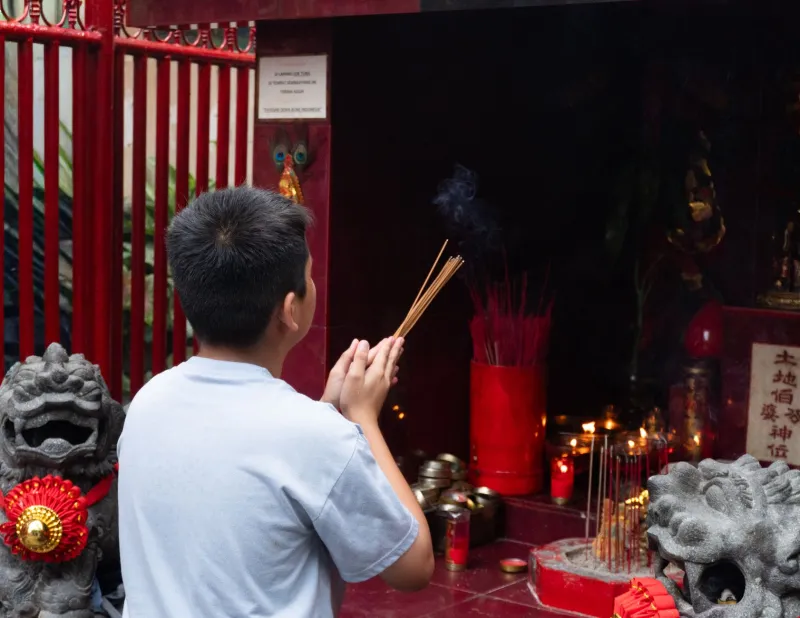
On a Sunday morning in Lowell, Massachusetts, 14-year-old Maya Souk is mid-scroll when her mom calls from the kitchen. Not for breakfast. For the altar. The family's weekly offering to the ancestors — sticky rice, oranges, a cup of jasmine tea — doesn't wait for the algorithm.
"She knows," says her mother, Chanthy, a Cambodian American woman who came to the US in the early 2000s. "She puts the phone face-down. Every time. But I still have to call her."
That small moment — the calling, the putting-down, the showing up — is playing out in Southeast Asian American households from Little Saigon to Minneapolis to the suburbs of Atlanta. Parents who grew up straddling two worlds are now raising kids who are straddling about five of them simultaneously, and the negotiation between digital life and cultural life has become one of the defining tensions of this generation.
The Altar Doesn't Have a Notification Setting
For many Southeast Asian American families, spiritual and cultural practice isn't scheduled. It's woven into the rhythm of the home — a Buddhist shrine in the corner of the living room, a Lunar New Year countdown that begins weeks before the date, a Sunday ritual that nobody put on Google Calendar because it was never supposed to need one.
That's where the friction starts.
"My kids live in a world where everything has a reminder," says Linh Tran, a Vietnamese American mother of three in San Jose. "But culture doesn't work like that. You don't get a push notification that says 'time to respect your elders.' You just have to already know."
Linh started what she calls "no-phone Sundays" not as a punishment but as a preservation strategy. The family cooks together, watches Vietnamese variety shows from her childhood, and lights incense before dinner. Her teenage son initially called it "boring." Now he asks what they're making.
"He doesn't say it's his favorite thing," she laughs. "But he shows up. That's enough for now."
Code-Switching Isn't Just About Language Anymore
Educators who work with Southeast Asian American youth say the concept of code-switching — traditionally about language — has expanded dramatically. Kids aren't just toggling between English and Tagalog, Khmer, Hmong, or Vietnamese. They're toggling between entirely different value systems, sometimes within the same hour.
"At school, they're learning to perform independence, individuality, self-expression," says Bao Xiong, a Hmong American community educator based in St. Paul. "Then they come home and they're expected to prioritize the collective, defer to elders, participate in rituals they might not fully understand yet. TikTok is all about 'this is me.' The altar is about 'this is us.' That's a big switch to make at 13."
What Bao has noticed, though, is that the kids who struggle most aren't the ones who love their phones — it's the ones whose families never explained the why behind the traditions. When parents make space for questions, the code-switching gets easier.
"One girl I work with started making Reels about her family's Hmong New Year prep," he says. "Her parents were skeptical at first. But she was asking her grandma questions she'd never asked before because she needed the content. The camera gave her permission to be curious."
When the Phone Becomes the Bridge
This is the part of the story that surprises people: sometimes the very technology parents fear is the thing bringing families closer to culture.
In the Filipino American community in Daly City, California, a group of parents started a private Facebook group not to complain about screen time but to share Filipino folk songs, traditional game tutorials, and short explainers about regional festivals that their kids could actually watch on their own terms. The group now has over 800 members.
"I can't always explain Flores de Mayo in a way that lands with a 10-year-old," admits one of the group's founders, who asked to go by Ate Cora. "But if I find a cute YouTube video that shows kids in the Philippines doing it, suddenly my daughter wants to know everything. The screen opened the door."
Similar dynamics are playing out in Thai American, Lao American, and Indonesian American families who are using YouTube, TikTok, and even Discord servers to create what researchers are calling "heritage media spaces" — informal digital environments where cultural content gets curated, shared, and discussed alongside the mainstream stuff.
The Generation That Gets to Decide
For Gen Z Southeast Asian Americans, the tension their parents feel isn't always felt the same way. Many of them don't experience TikTok and temple as opposites — they experience them as different channels of the same identity.
"I post about Tet. I post about my grandmother's cooking. I post about K-pop and my high school drama," says Jade Nguyen, 17, from Houston. "It's all just... me. My parents think I have to choose. I don't think I do."
Jade's TikTok account, which she started during the pandemic, has become an unexpected archive of her family's Vietnamese American life. Her most-viewed video is of her grandmother teaching her to make bánh chưng, scored to a lo-fi beat. It has over 200,000 views.
"My grandma didn't know what TikTok was," Jade says. "But she watched that video on my phone and she cried. She said, 'Now people will remember.' That's when I understood why my parents cared so much."
What Gets Lost, What Gets Found
Nobody's pretending this balance is easy or that the stakes are low. Cultural anthropologists who study diaspora communities point out that the speed of digital culture — the constant novelty, the dopamine loops, the pressure to perform — can erode the patience that traditional practices require. Sitting with elders. Listening to long stories. Learning a ritual by watching it done slowly, over years.
"There are things you cannot learn from a video," says Dr. Phuong Nguyen, a cultural studies researcher at UC Riverside. "The embodied knowledge, the feeling of being in a space with your community — that requires presence. The risk isn't that kids love their phones. It's that they start to believe presence is optional."
But she's also careful not to frame technology as the villain. "Every generation has had to figure out how to carry culture forward through new tools. This generation is doing it with cameras in their pockets. Some things will be lost. Some things will be found in new forms. That's always been the deal."
Back in Lowell, Chanthy watches her daughter Maya arrange the Sunday offerings — sticky rice, oranges, jasmine tea — with the kind of quiet care that doesn't come from a tutorial. It comes from years of Sundays.
"She'll do this for her kids someday," Chanthy says. "Maybe she'll film it. Maybe her kids will post it somewhere. I don't know. But she'll do it. I know she will."
The phone stays face-down on the kitchen counter. The incense rises. The algorithm will still be there when they're done.