Eight Limbs, One Diaspora: How Lao, Thai, and Cambodian American Gyms Became the Backbone of America's Combat Sports Boom
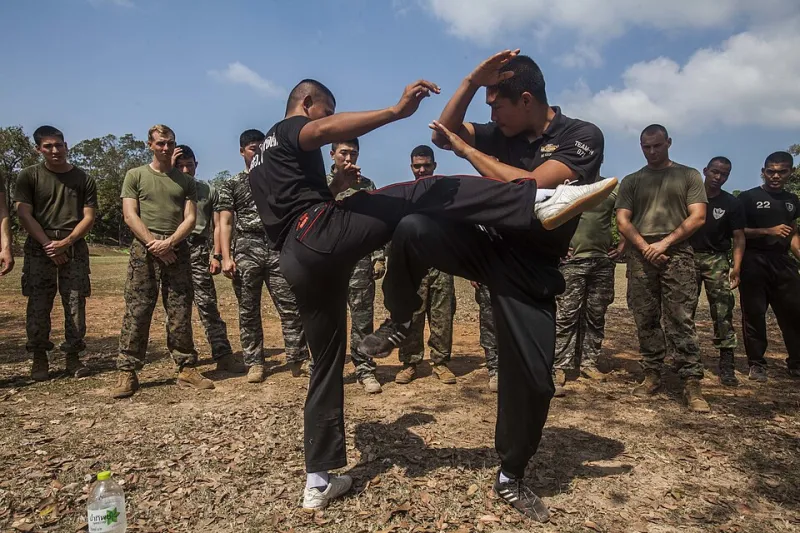
Photo: Gunnery Sgt. Ismael Pena, Public domain, via Wikimedia Commons
Walk into most American MMA gyms today and you'll hear it in the warm-up: the rhythm of Muay Thai pads, the clinch, the teep. The 'art of eight limbs' has gone from niche import to the striking foundation of American combat sports. But behind the highlight reels and the pay-per-view cards is a quieter story — one told in strip-mall gyms run by Lao, Thai, and Cambodian American families who kept these arts alive in the US long before they were cool.
The Strip-Mall Origins
Long before UFC broadcasts featured Thai pads, the sport survived in America through a handful of family gyms — often literally living rooms with bags hanging in the garage. Thai immigrants opened camps in Los Angeles and the Bay Area. Lao American families, many resettled after the war, built gyms in places like Stockton, Minneapolis, and Providence. Cambodian American trainers carried the traditions of Khmer boxing, an art nearly destroyed in the 1970s, into new gyms on both coasts.
These weren't lifestyle brands. They were labor-of-love operations: dads training kids after their own shifts, moms handling the memberships, fighters sleeping in the back room between tournaments. The mainstream didn't arrive for decades. The community did.
"We weren't trying to build an empire," one second-generation trainer in Long Beach puts it. "We were just trying to keep the gym open and keep the kids off the street. Turns out that was the business plan."
The Gym as Cultural Hub
Ask anyone who grew up in these spaces and they'll describe something closer to a community center than a fight camp. Weddings have been held at gyms. Fundraisers for temple projects, for disaster relief back in the motherland, for families in crisis — all organized through the same roster that shows up for pad work at 6 a.m.
The gym is also where heritage gets transmitted in ways parents' nights out never managed. Kids who drifted from the language of their grandparents still learn the Wai Kru, the ritual dance of respect before a fight. They learn why you touch the pads a certain way, why the mongkhon matters, why you never step over the ring ropes carelessly. Culture doesn't need a classroom when it has twelve-ounce gloves.
The Mainstream Question
Now comes the complicated part. Muay Thai is booming — fitness chains, influencer seminars, celebrity training montages. Lethwei, Burma's bare-knuckle cousin, is finding American audiences through viral footage and rising promotions. And with growth comes the question every diaspora community knows by heart: who gets credited?
Some gym owners are optimistic, pointing to fighters who openly rep their roots — Lao American champions wearing their heritage on their walkout shorts, Thai and Khmer traditions featured respectfully on broadcasts. Others see the familiar pattern: the techniques get adopted, the branding gets genericized, and the families who built the foundation get footnotes.
The trainers have a response, and it's characteristically practical: keep teaching, keep the rituals intact, keep the doors open to everyone. "If someone comes to learn the jab," one San Diego-based coach says, "they're going to learn the Wai Kru too. That's not negotiable. That's the whole art."
What Comes Next
The second generation is taking over now — American-born, social-media fluent, running gyms with the same family recipes and better marketing. Some are producing fighters on national cards. Others are building youth programs that double as mentorship pipelines. All of them understand something the fitness industry is only now figuring out: people don't just come for the workout. They come for belonging.
The boom will eventually cool. Chain gyms will open and close. But the family gym in the strip mall, with the grandma at the front desk and the smell of liniment in the air? That one's not going anywhere. It was never a trend. It was a promise.