Who Gets to Say What's Real: Southeast Asian American Food Critics Are Done Playing by the Old Rules
Let's start with a question that sounds simple and isn't: what makes a bowl of pho authentic?
Is it the recipe your grandmother used in Saigon? The version that got adapted when your family resettled in New Orleans and star anise was hard to find? The bowl at the strip mall restaurant in Houston that's been feeding the Vietnamese American community there for thirty years? The $22 version at the trendy downtown spot that got a glowing writeup in a major food magazine from a critic who'd never been to Vietnam?
Depending on who you ask, you'll get completely different answers. And for a long time in American food media, the people doing the asking — and the answering — were mostly not Southeast Asian.
That's changing. Slowly, with friction, and with a fair amount of internal disagreement that doesn't get enough airtime.
The Gatekeeping Was Never Subtle
Anyone who's spent time in mainstream American food media knows the shape of the problem. The publication that sends a non-Vietnamese critic to review a Vietnamese restaurant and leads the review with a paragraph about how the food reminded them of a trip they took to Hanoi once. The food television segment that positions a Southeast Asian dish as "exotic" and "adventurous" while a white host takes their first bite on camera. The Yelp review ecosystem that rewards restaurants for catering to non-Southeast Asian palates and punishes them with one-star complaints about "too spicy" or "smells weird."
None of this is new, and none of it is exclusive to Southeast Asian food. But the specific dynamics around Southeast Asian cuisine in America carry some particular baggage — the refugee and immigration history that brought many of these food traditions here, the economic precarity of a lot of Southeast Asian restaurant families, and the way "cheap and authentic" has been used as a marketing frame that simultaneously celebrates and condescends to these communities.
Southeast Asian American food writers have been pushing back on this for years. What's different now is the platforms they have to do it from.
Authenticity Is a Moving Target — And Always Has Been
Here's where it gets interesting, and where the Southeast Asian American food writing community itself starts to fracture in productive ways. Not everyone agrees on what the pushback should look like.
One camp — and it's a vocal one — argues that the whole concept of "authentic" Southeast Asian food is a trap, regardless of who's wielding it. Food evolves. It always has. The pad thai that's now considered quintessentially Thai was essentially invented in the mid-20th century as a nationalist project. Vietnamese baguettes exist because of French colonialism. Filipino adobo absorbed Spanish influence centuries ago. Insisting that any cuisine stay frozen at some imaginary point of cultural purity isn't preservation — it's a kind of culinary taxidermy.
From this perspective, a Lao American chef in Portland putting fermented fish paste in a dish that also features locally foraged mushrooms isn't betraying anything. She's doing what cooks have always done: working with what's available, honoring what she knows, and making something new.
The other camp isn't entirely wrong either, though. There's a real difference between a Southeast Asian American chef evolving a tradition from the inside and a non-Southeast Asian restaurant group appropriating the aesthetic of a cuisine for profit while the communities that created it struggle to survive. The concern isn't change itself — it's who benefits from the change and who gets erased in the process.
The Price Point Problem
One of the sharpest fault lines in this conversation runs straight through the question of price. For decades, Southeast Asian food in America has been expected to be cheap. It's a legacy of the economic circumstances under which many of these restaurants were opened — refugee families with limited capital, working-class immigrant communities feeding other working-class immigrant communities, survival economics that kept margins razor-thin.
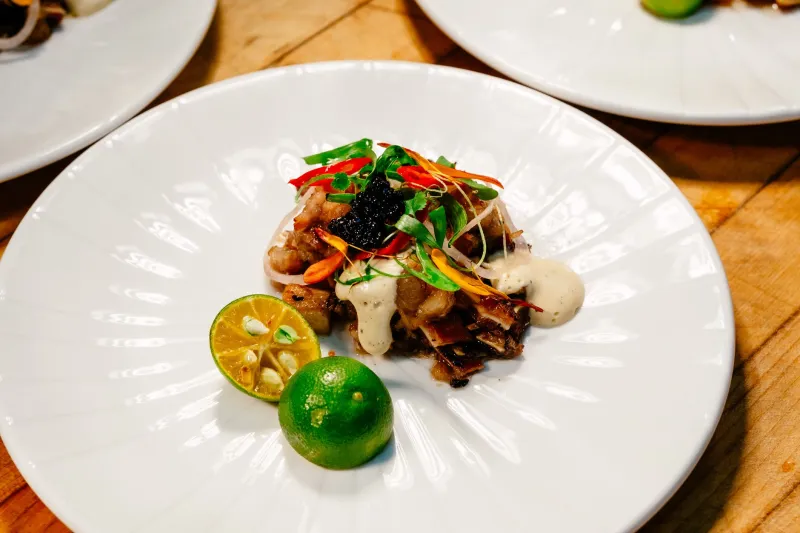
When Southeast Asian American chefs started opening restaurants that charged more — fine dining interpretations of regional cuisines, tasting menus built around Filipino or Thai or Vietnamese ingredients, prix fixe experiences that asked diners to take the food seriously as cuisine rather than just as cheap ethnic eats — the reaction was loud and divided.
Some critics, both inside and outside these communities, celebrated it as overdue recognition. Others — including a significant number of Southeast Asian American voices — pushed back hard. Whose food are you making when you charge $150 for a tasting menu inspired by your grandmother's cooking? Who can afford to eat it? What happens to the strip mall restaurants that fed the community for forty years when the neighborhood starts to gentrify around a prestige version of the same food?
These aren't rhetorical questions. They're real tensions that Southeast Asian American food writers are grappling with in real time, in public, with real disagreement.
The Critics Making Noise
The food writers doing the most interesting work in this space right now are the ones willing to hold all of this complexity at once. They're not interested in simple narratives — not the "finally, Southeast Asian food gets its due" victory lap, and not the "you've betrayed your roots" accusation either.
What they're doing is insisting on specificity. Not "Southeast Asian food" as a monolithic category, but Thai food from Isan versus Bangkok. Not "Vietnamese cuisine" but the specific regional and generational variations that get flattened when the whole thing gets reduced to pho and banh mi for American audiences. Not "Filipino flavors" but the particular history of how those flavors arrived in Los Angeles or Chicago or New Jersey and what they became there.
This kind of writing requires a different skill set than traditional restaurant criticism. It's part food writing, part cultural history, part community journalism. It asks the critic to know things that can't be learned from a single restaurant visit — to understand the context that a dish carries, the community it feeds, the economic and political conditions that shaped it.
Fusion Isn't a Dirty Word
One thing the best Southeast Asian American food critics seem to agree on: the word "fusion" has been unfairly tainted. For a while in American food culture, fusion became shorthand for confused, for inauthentic, for a chef who doesn't know what they are. But fusion has always been how food actually works. Every cuisine you can name is a fusion of something.
The difference between fusion that works and fusion that doesn't isn't about cultural purity. It's about knowledge, intention, and respect. A Cambodian American chef who grew up eating both amok and Tex-Mex and finds a way to make something that honors both isn't confused — she's specific. She's making food that reflects an actual life actually lived. That's not less authentic. It might be more.
The Southeast Asian American food critics pushing this argument aren't asking for a free pass for every poorly conceived fusion menu. They're asking for a more honest framework — one that evaluates food on what it's actually trying to do and whether it does it well, rather than whether it conforms to someone else's idea of what the culture should look like.
That's a harder standard to meet, honestly. But it's the right one.